

Why the customer you keep beats the lead you buy
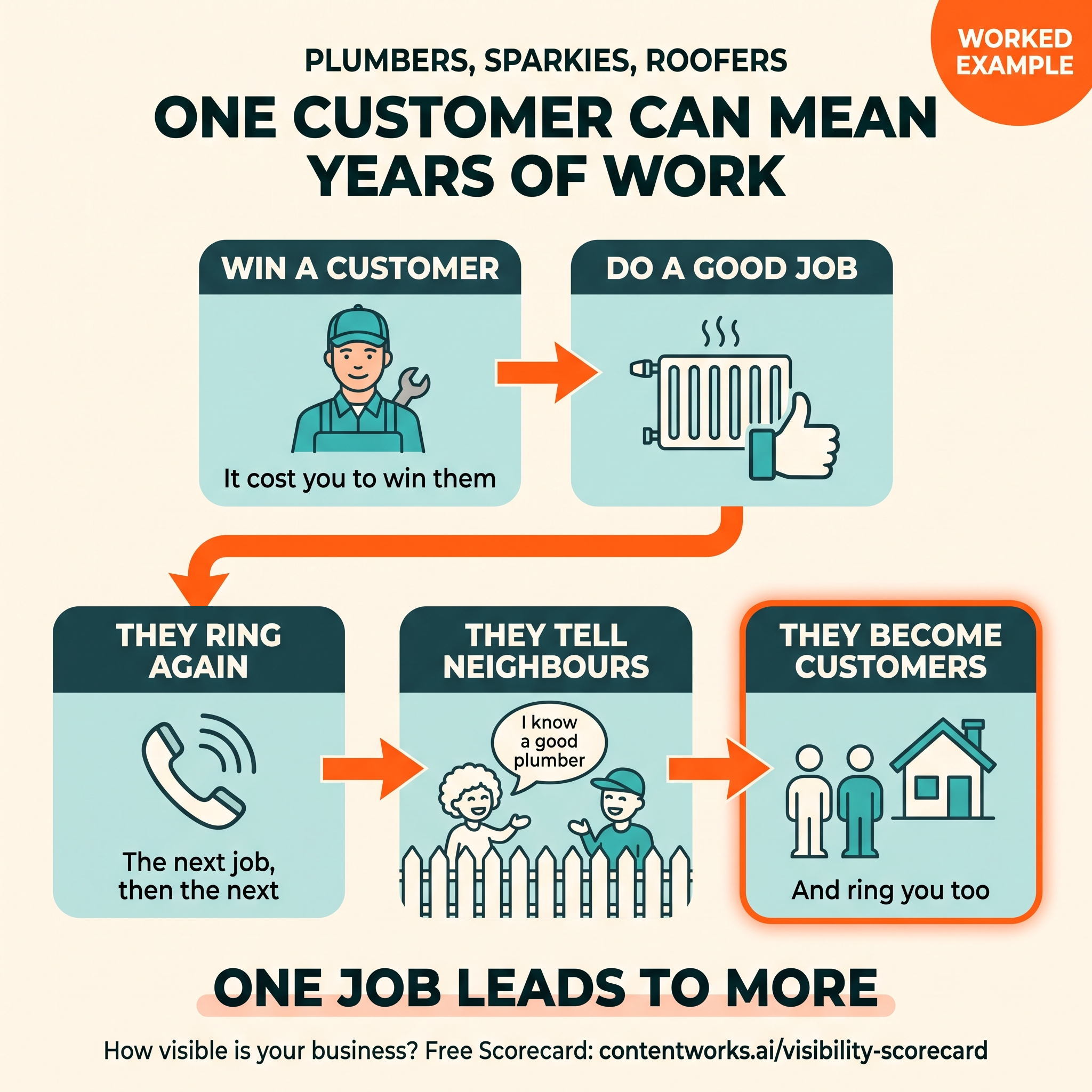
A customer from Checkatrade, Bark or an ad cost you money to win. A customer you keep rings you again, and sends their neighbours, without a lead fee.
Here’s how the two compare. We’ll look at what a customer cost you to win, why the ones you keep ring you again, and why they pass your name on. Then you can work out your own numbers on the back of an envelope.
In short
- A customer from a platform, a lead or an ad cost you something to win: a membership, lead credits, ad spend, or the marketing you pay for
- A customer you keep rings you again for the next job, and you don’t pay to win them a second time
- Happy customers tell friends and neighbours “I know a good plumber”, and that work comes to you without a lead fee
- You can work out what one customer is worth to you with four numbers from your own records
What did that customer cost you to win?
Start with where the job came from.
Maybe it came through a monthly Checkatrade membership. Maybe you spent credits on a Bark lead, paid for a lead somewhere else, ran some ads, or paid someone to do your marketing. Either way, money went out before that customer ever rang.
And that money doesn’t come back with the job. The invoice covers your time, your materials and your margin. It doesn’t cover what it took to get the phone to ring in the first place.
So when the job’s done and you never speak to that customer again, the next job has to be won from scratch. New lead, new spend, new quote against whoever else they called.
A customer you keep rings you again
This is the part that’s easy to underestimate. A boiler, a garden, a roof, a set of walls … they all need looking at again.
Picture Dave, a heating engineer. He fits a new boiler. That boiler will want regular servicing. A few years on, the customer wants a radiator moved for a kitchen refit. Then the hot water plays up one winter.
Every one of those is a job Dave can have without paying to find the customer. They already know him, they already trust him, and his number’s in their phone. The only question is whether they remember him when the time comes, or search for someone new.
The same goes for most trades. A landscaper who does the garden this spring is the obvious call for the hedge and the fence next year. A decorator who does the front room gets asked about the hallway.
You can’t just do a job, price it up, go and do it, and forget about it. The first job is where the relationship starts.
“I know a good plumber”: why they send you their friends
There’s a second payoff.
When a customer’s happy, they talk. A neighbour mentions a leak over the fence. Someone asks in the family group chat who did their bathroom. And your customer says “I know a good plumber” and passes your name on.
That new customer comes to you already half sold. You didn’t pay for the lead, and they’ve already heard you’re good before you pick up.
Over time, one good customer can turn into years of repeat work and a string of new customers they’ve sent your way. That’s what “lifetime value” means for a trades business. It’s the first job, plus every job after it, plus every job from the people they recommend you to.
Does every customer do that? No. But the ones who do are worth far more than the first invoice, and you rarely know which ones they’ll be when you take the job.
Worked example: work out your own numbers
No figures from us here. Your numbers are the only ones that count, and they’ll be different for every trade and every patch. Grab last year’s records and fill in the blanks.
- What you spent on getting work last year. Platform memberships, lead credits, ads, website, anyone you paid to market you. Your number: ______
- How many new customers came from that spend. Your number: ______
- What one new customer cost you to win. Divide line 1 by line 2. Your number: ______
- Think of your best customer. Add up their first job, every job they’ve had from you since, and any job from someone they sent your way. Your number: ______
Now put line 3 next to line 4.
Line 3 is what you pay every time you have to find a new customer. Line 4 is what one customer can be worth when you keep them. If you’ve never put those two side by side, it’s worth ten minutes with a pen.
What you can do this week to keep customers coming back
None of this needs a big budget. It needs a habit.
- Keep their details somewhere you’ll find them. Name, number, address, what you did and when. A spreadsheet works. So does a notebook.
- Note when the next job will be due. The boiler service, the gutter clear, the lawn’s first cut, the paintwork on the south side. Then drop them a line when it comes round, so they ring you and not a stranger off the internet.
- Ask for a review while the job’s fresh. A review on your Google profile helps the next customer pick you, including the friend your customer recommends you to.
- Make it easy to recommend you. Leave a card. Make sure your name, number and Google profile are the same everywhere, so when someone looks you up after a recommendation, everything they find points to you.
That last one matters more than it sounds. When a neighbour passes your name on, the next thing the new customer can do is look you up. What they find on Google, on Maps, in your reviews and on your website decides whether they ring you.
Frequently asked questions
What is customer lifetime value for a tradesperson? It’s everything one customer is worth to your business over time: the first job, every repeat job, and every job from people they recommend you to. It can be worth far more than the first invoice.
How do I keep past customers coming back without being pushy? Keep in touch when there’s a real reason, like a service falling due or a seasonal job coming round. A short, useful message from someone they already trust doesn’t feel like selling.
How do I get more customers to recommend me? Do a good job, ask for a review while it’s fresh, and make sure you’re easy to find when someone looks you up. A recommendation only turns into work if the new customer can find you and likes what they see.
See what a recommended customer finds
When someone says “I know a good plumber”, the new customer goes looking. Your Google profile, your reviews, your website and what AI tools like ChatGPT say about you all shape whether that recommendation turns into a call.
The Visibility Scorecard shows you how visible you are when a local customer goes looking for you. It’s free, and your results show on screen straight away.
Take the free Visibility Scorecard
Ready to see where you’re losing work?
Get your free Visibility ScorecardAbout 4 minutes. No call. No catch.
Get your free Visibility Scorecard →

Dan Jaques founded ContentWorks in Bournemouth. We’re the marketing department your trades business never had. We run all your marketing, so you can get on with the job.
Dan didn’t come to trades from marketing… he came to marketing from trades. His granddad was a carpenter, his uncles fitted kitchens and plumbed bathrooms, and he was on the tools himself at 16: carpentry, roof trusses, building sites, and furniture built on the side and sold at weekend markets. The marketing came later, and not in a straight line: market stalls, five clothing shops, early e-commerce, then SEO worked out by doing it and breaking it. He has run local marketing since 2014, originally as Dan Jaques Online Marketing, and ContentWorks followed in 2023.
Long gone are the days of just hiring an SEO. We run your marketing, from the first search to the next job. AI-powered, human-led.